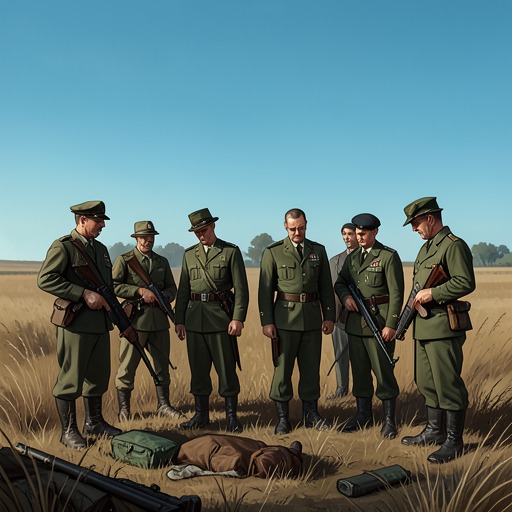
Cross-border reconnaissance mission
The SympathizerThe Cross-border reconnaissance mission sends a twelve-person party from the admiral’s camp into Laos, where its passage through bomb-scarred terrain turns a military expedition into an encounter with the landscape and history of the war. The party is assembled from exiles, former enemies, and unwilling guides; its weapons and blessings sit beside a pocket radio broadcasting love songs across the border. The account records the mission’s preparations and first march, but not its eventual outcome.
Preparation and Participants
After two weeks spent adjusting to the weather and their new comrades, the unnamed narrator and Bon find three marine lieutenants among the men who will join the mission. The narrator had encountered them before in a Saigon alley, where they sang about Saigon. On the day the city fell, the three made their way to the docks and boarded the admiral’s ship; they had been in Thailand ever since. Their return is an unexpected reunion, made awkward by recent hostility: the dark marine is the same man at whom the narrator had previously drawn his pistol. The marine does not mention it, and the narrator follows his lead. They shake hands, a grudging gesture that makes cooperation possible without pretending the past has disappeared.
The team sets out with a Lao farmer and a Hmong scout at its head. The farmer is not a volunteer: the admiral’s men kidnapped him on an earlier reconnaissance and now use him as a guide because he knows the terrain. He cannot speak Vietnamese, so the scout translates for him. The scout’s ruined-looking eyes and oversized, faded green beret distinguish him as he leads the party through the border country. Their expertise is essential to the route, but the farmer’s presence also exposes the coercion underpinning the expedition.
The remaining members follow in a carefully described order. Two marines carry an AK-47 and an M79 grenade launcher; behind them come the affectless lieutenant and the grizzled captain, who carry M16s rather than the enemy’s AK-47. A radio operator carries a PRC-25 radio and a grease gun. The philosophical medic bears both an M3 medical kit and an M14, while a machine gunner carries an M60. The unnamed narrator takes an AK-47, Bon an M16, and the last marine brings up the rear with a B-40 rocket launcher. No one goes unarmed. The arrangement makes the party’s discipline visible, while its assortment of weapons records the uneasy joining of men whose military histories do not neatly align.
Equipment, Belief, and the Mission’s Purpose
The party is preparing to reconnoiter a route through the southern end of Laos, terrain the marines have probed before and the Lao farmer knows as home ground. He says smugglers cross the border regularly. The mission’s specific intelligence objective is not stated in this account, but the map study, prior reconnaissance, and use of a local guide establish it as a deliberate military passage rather than a journey without a plan.
For protection, the men receive no helmets or bulletproof vests. Instead, each wears a laminated, wallet-sized picture of the Virgin Mary over his heart, blessed by the admiral as the party leaves camp. The narrator notes that the gifts are a relief to most of the men, a response that lends the images a practical and emotional value without suggesting that they can stop bullets. Claude, who believes in neither Mary nor any god, offers a secular send-off with high fives and advice to keep quiet, stay low if shooting begins, and let the professionals fight. He has taught the narrator, alongside Man, the practices of intelligence and secrecy, and his concern for the narrator is personal as well as professional. The narrator recognizes that Claude’s estimate of his fighting ability is probably right.
Radio Free Vietnam broadcasts from a bamboo shack beside the admiral’s hut. Its programming combines speeches, translated newspaper items, and popular songs, including music by James Taylor and Donna Summer. The admiral presents the broadcasts as serving people who still want love songs, in contrast to the communists’ asserted demand that people love only revolution and country. The songs travel across Laos toward the homeland. The narrator carries a transistor radio and earpiece in his pocket and values them more than his weapon or the Marian image. This small preference gives the mission a counterpoint to its arsenal: the radio carries feeling and a claim to cultural connection where the weapons signify danger and political division.
The March into Laos
The twelve depart early one night beneath a sliver of moon. At first, the strenuous walk gives the narrator a buoyant sense of energy; after an hour, that feeling drains away into fatigue. A few hours into the march, the grizzled captain calls a halt at a pool. By the watch’s dimly visible hands, it is one in the morning. The narrator’s thighs ache, and his hands seem detached as he longs for a cigarette. Beside him, Bon silently eats a rice ball.
A dead finch floats among feathers on the foul-smelling water. Bon identifies the pool as a bomb crater, and the crater becomes a sign that the party has entered Laos: an American military footprint made legible in the land itself. The team encounters more craters as it travels east, sometimes singly and sometimes in clusters, and picks its way around uprooted cajeputs scattered by explosions. Near a village, the men see fishing nets set beside the craters, where farmers have stocked the water with fish. The route therefore passes through ground altered by bombing but also incorporated into ordinary local life.
Near dawn, the grizzled captain stops at a hilltop that the Lao farmer describes as isolated and rarely visited. The men spread ponchos beneath cajeputs and cover themselves with netting hooded with woven palm fronds. The narrator’s rucksack holds rations and a copy of Asian Communism and the Oriental Mode of Destruction hidden in a false bottom, preserving a concealed connection to the book he may need again. The team takes turns on three-hour sentry shifts. Woken for his turn, the narrator finds that the sun is already high and his throat parched. Through binoculars he can see the Mekong in the distance, roads and paths, farmhouses and brick factories, farmers with water buffalo in the rice paddies, and the ruins of an ancient temple. From the night march’s cramped fatigue, the narrative opens into a broad daylight view of a lived-in border landscape.
Narrative Significance and Limits
The mission’s opening movement joins military procedure to the narrator’s reflective attention to objects and terrain. The formation and weapons specify how the party travels; the Marian pictures, radio, hidden book, rice ball, and cigarette longing register the private habits and beliefs carried alongside its military purpose. The American bomb craters are not merely obstacles: they mark the border crossing and show how a past campaign has shaped the ground the reconnaissance team now traverses.
The group’s cohesion remains conditional. The narrator and the dark marine can shake hands without resolving the earlier pistol encounter; the Lao farmer guides men who have kidnapped him; and Claude’s protective advice acknowledges that the narrator may be less capable in combat than the other men. The account ends with the narrator observing the terrain from the hilltop, not with a reported discovery or a completed mission. Its immediate achievement is to establish the party, its route, and the vulnerabilities carried into the reconnaissance.